
 1 weeks ago
 Trần Dũng
Shop around for composite planters and you will often see two planters of the same size, almost identical from the outside, at very different prices. Most of that difference hides in the one place you cannot easily see: wall thickness. This guide explains why shaving off just a few millimetres cuts costs so much, why it weakens the planter far more than you might expect, and how to check before you buy.
Same size, different price: why?
Composite planters are cast from polyester resin, fiberglass and stone powder. The amount of material in a planter is roughly the area of its walls and base multiplied by the thickness. So when the walls get thinner, the material drops in the same proportion — and so do the labour for laying up each layer, the curing time and the shipping cost.
The key point is that surface area grows very quickly with planter size. Taking 1 mm off the wall saves only a few hundred grams on a small planter, but around ten kilograms on a large one:
| Planter size | Wall + base area | Material per 1 mm of thickness |
|---|---|---|
| Square 20 × 20 × 20 cm | 0.20 m² | about 0.4 kg |
| Square 60 × 60 × 60 cm | 1.80 m² | about 3.4 kg |
| Rectangular 100 × 40 × 50 cm | 1.80 m² | about 3.4 kg |
| Round Ø90 cm, 90 cm tall | 3.18 m² | about 6 kg |
| Round Ø140 cm, 90 cm tall | 5.50 m² | about 10.5 kg |
Estimated with a fiberstone composite density of about 1.9 g/cm³. Real figures vary with each factory’s formula.
In other words, on a large planter, making the walls just 2–3 mm thinner saves tens of kilograms of material per piece. That is why the price gap between Furnio planters and cheap planters on the market is usually widest in the large sizes.
A little thinner — how much weaker?
A planter wall behaves like a panel being pushed outward by the soil. In basic mechanics, a panel’s strength does not drop in step with its thickness — it drops much faster:
- Stiffness (resistance to bulging and warping) is proportional to the cube of the thickness.
- Bending strength (resistance to cracking) is proportional to the square of the thickness.
| Wall made thinner by | Material saved | Stiffness left | Bending strength left |
|---|---|---|---|
| 10% | 10% | about 73% | about 81% |
| 20% | 20% | about 51% | about 64% |
| 30% | 30% | about 34% | about 49% |
For example, a planter with walls 20% thinner saves only 20% of the material, yet keeps only about half its stiffness. You cannot see this when buying — a new planter still looks great — it only shows after a few months of holding soil in the sun and rain.
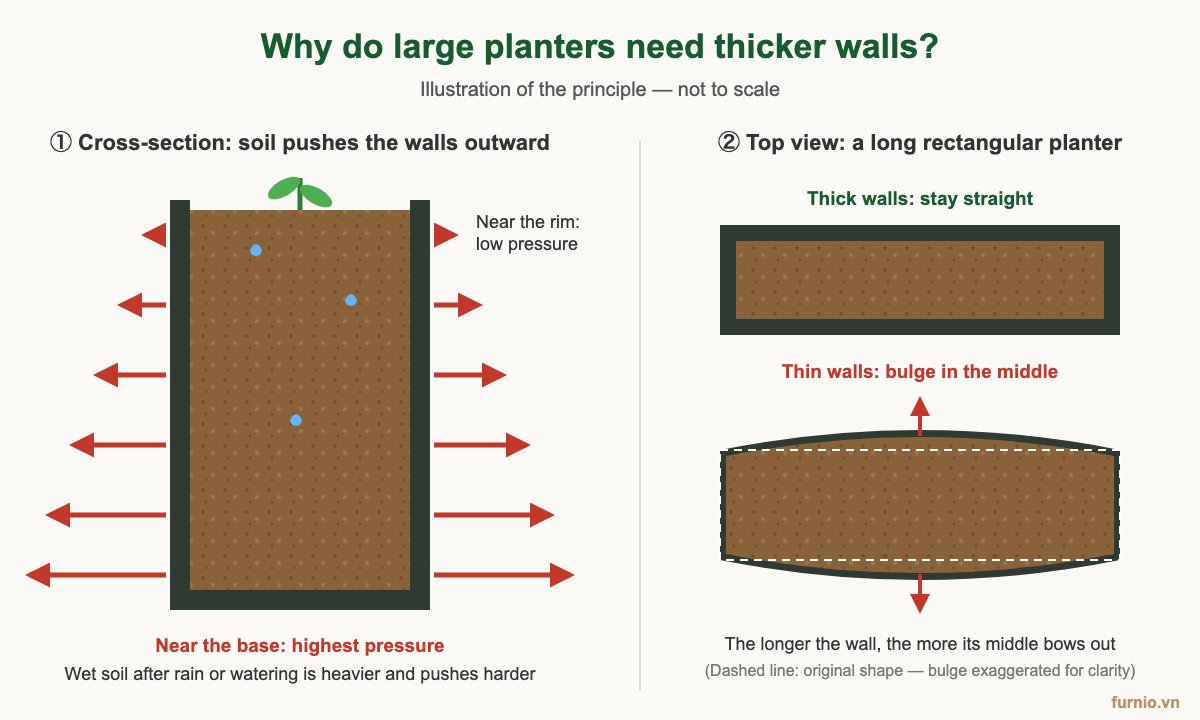
Why do large planters need thicker walls?
- Soil pushes harder near the base: the sideways pressure of soil increases with depth. The taller the planter, the more load on the lower walls — especially when the soil is soaked after rain or watering.
- Wider walls bulge more easily: a flat panel’s deflection grows very quickly with its length. A 1 m rectangular trough has large flat walls, so thin walls easily bulge in the middle or crack at the corners.
- Balconies and rooftops: large planters with tall plants also take wind loads, plus knocks during transport and crane lifting.
Common signs of thin-walled planters after a while in use: walls bulging in the middle, a warped rim, hairline cracks at the corners or base.
At Furnio, the larger the planter, the thicker we make its walls.
See the walls for yourself at the Furnio factory
Rather than reading specifications, look at the rims in these two videos filmed at the Furnio factory. The rim is where wall thickness and solidity are easiest to see.
Rectangular planters during finishing
A worker prepares the inside of each planter before the surface finish. Watch the rims of the long troughs — the part most prone to bulging when walls are thin.
Finished round planters at the factory
Rows of finished round planters — from above you can clearly see the thick, even rims.
How to check wall thickness when buying
- Ask for the wall thickness in mm for the exact size you plan to buy. A maker of thick-walled planters will answer straight away.
- Measure the body, not just the rim: rims are often folded thicker than the walls, so a thick rim does not guarantee thick walls. You can measure through the drainage hole.
- Compare weights between sellers for the same size — together with the thickness, for a fair comparison.
- Press the middle of the wall (on large planters): thin walls flex slightly or sound hollow when tapped.
- Check corners and base: the surface should be smooth, with no hairline cracks at the corners.
Wall thickness at Furnio
Furnio makes fiberstone composite planters to export standards, increasing wall thickness with planter size. Before finishing, every planter is fully sanded and waterproof-coated inside, then painted with UV-resistant color or given a polished terrazzo surface.
Learn more about the material in What is a fiberstone planter? For a quote by size, or to see the surplus export stock we currently have at factory prices, message us on WhatsApp at +84 908 458 579.
Frequently asked questions
Is a heavier composite planter always better?
Not necessarily. Weight only means something alongside wall thickness. Compare both: for the same size, the planter with thicker walls will be stiffer and last longer.
Why do prices differ more for large planters than small ones?
Because large planters have a lot of wall area, each millimetre of thickness means a lot of material. Shaving a few millimetres off a large planter saves a lot of cost — but also weakens it considerably.
How can I check wall thickness when buying online?
Ask the seller for the thickness in mm and the weight of the exact size you are buying, with a photo of a caliper measurement on the planter body.


Need help choosing a planter?
Send us your sizes or photos of your space and the Furnio factory will suggest suitable models and quote you directly, in English. We often have surplus export stock at factory prices.