
 1 weeks ago
 Trần Dũng
There are composite planters at every price point on the market today. Some look almost identical from the outside yet sell at very different prices. One of the main reasons is how they are built and made: the two most common types are one-piece cast composite planters and planters glued together from PVC panels. This guide explains how the two differ, why their prices differ, and how to tell them apart when you buy.
Both are called “composite planters”, but they are made in two different ways
When you shop, you will see both types sold simply as “composite planters”, in the same square, rectangular, grooved and stone-effect styles. The difference is on the inside:
- One-piece cast planter: the walls and base are formed as a single piece in a mold, from fiberglass-reinforced resin.
- Glued PVC-panel planter: foam PVC sheets (often called “formex” in Vietnam) are cut to size and glued together, then painted.
One-piece cast composite planters: seamless and solid
These planters are cast from high-grade polyester resin reinforced with fiberglass, blended with stone powder (fiberstone), forming the whole body in one seamless piece.
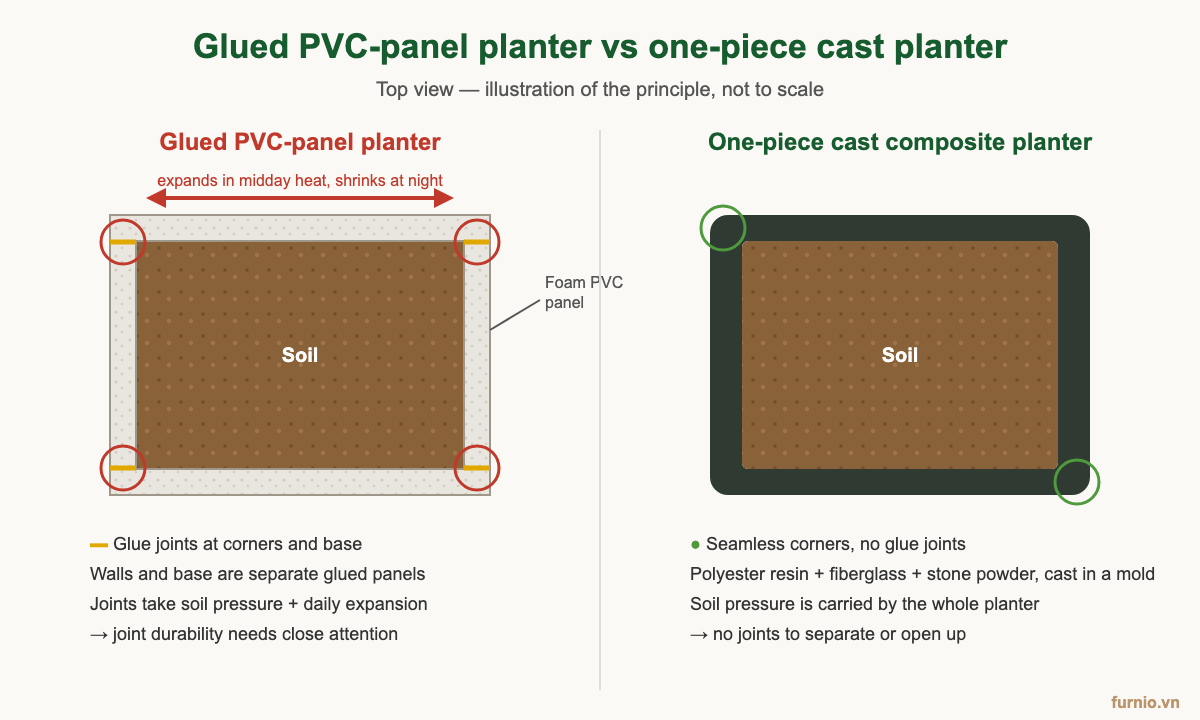
- One-piece structure: no joints between wall panels, so there is little risk of seams opening or bonds failing.
- Rigid and stable: the outward push of the soil is carried by the whole planter, not concentrated on a glue line.
- Much lighter than concrete or terrazzo: easy to transport and place on balconies and rooftops.
- Made for outdoor use: composite stands up well to the weather when it is made properly, with the right thickness and surface finish.
- Long service life: with the right material quality, thickness and process, the planter serves for many years indoors and out.
One-piece cast rectangular planters being finished at the Furnio factory — seamless corners, no joints.
Glued PVC-panel planters: watch the joints
These planters are formed from PVC panels glued together.
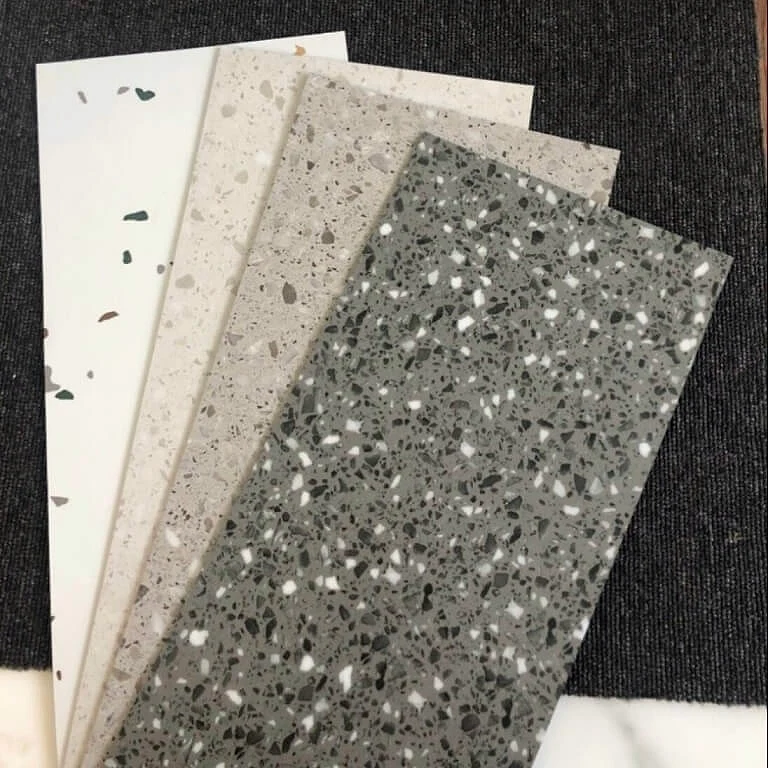
Terrazzo-pattern PVC sheets: the surface is printed to look like terrazzo, and the sheets are cut and glued into planters.
- Jointed structure: the joints must be finished carefully to hold together and keep water out.
- Strength depends on workmanship: the quality of the PVC sheet, the glue, the surface preparation and the assembly all affect durability.
- Outdoor use: consider resistance to UV, heat and humidity, and how the glue holds up over time. Not all PVC sheets and glues handle the weather equally.
- Service life: depends on material quality, construction, workmanship and real-world conditions.
Why are glued PVC planters cheaper?
The price difference comes from the way they are made:
| Glued PVC-panel planter | One-piece cast composite planter | |
|---|---|---|
| Material | Ready-made foam PVC sheet, inexpensive | Resin, fiberglass and stone powder, built up in layers |
| Mold | No mold needed, sizes easy to change | Each model needs its own mold |
| Process | Cut, glue, paint — quick to make | Lay up each layer, cure, demold, fully sand, then finish |
| Weight | Very light (foam core) | Heavier than glued planters, much lighter than concrete |
In other words, glued planters save on material, molds and production time, so they sell for less. What matters is knowing which type you are buying, so you put it in the right place.
Technical points about foam PVC outdoors
- Temperature limit: according to one foam PVC manufacturer’s technical data sheet, the recommended service temperature is only about −10 to 55°C. Meanwhile, dark surfaces in the midday summer sun can reach 60–70°C. Dark grey or black planters on sunny rooftops and balconies can therefore warp or lose their shape over time.
- Thermal movement: PVC sheet expands and contracts quite a lot with temperature. A 1 m panel can grow and shrink by about 2 mm between the midday sun and the cool night. The glue joints at the corners are pulled back and forth like this every day, on top of the outward push of damp soil, so the long-term durability of the glue deserves special attention.
- UV protection comes from the paint: PVC left in the sun can yellow, chalk and gradually become brittle. The paint coat is the main protection; once it is scratched or peels, the core underneath is exposed to direct sun.
To be fair, foam PVC barely absorbs water, does not rot, is very light and can be made to any size. Glued PVC planters remain a sensible, budget-friendly choice for small planters, planters for artificial plants (no soil, so almost no load on the walls), planters indoors or under cover, or short-term decoration such as events and displays. For these uses, an inexpensive glued planter from an online marketplace is perfectly adequate.
How to spot a glued-panel planter when buying
- Look closely at the corners: glued planters usually have a seam along each edge, sometimes hidden under paint or trim.
- Look at the core through the drainage hole: glued PVC planters have a white foam core; cast composite planters have a solid core.
- Lift it: a glued PVC planter is noticeably lighter than a cast planter of the same size.
- Ask the seller directly: “Is this planter cast in one piece or glued from panels? What is it made of?” A transparent maker will answer straight away.
Choose more than the price tag
If the planter is going on a balcony, rooftop, garden or a project meant to last, look beyond the initial price. For example, a garden café needs many planters standing outdoors all year in sun and rain; replacing a batch of warped planters with open corners after a while usually costs more than the price difference at purchase. Ask yourself:
- Is the planter’s structure solid?
- Is the material suited to sun and rain?
- Could the joints separate or open up over time?
- Is the inside waterproof-coated, so water does not seep onto your floor?
- Is the weight right for where it will stand and how it will be moved?
- Does the maker clearly explain the material, the production process and the warranty?
For cast planters, wall thickness also has a big effect on durability and price — see Composite planter wall thickness: why same-size planters differ in price.
One-piece cast composite planters at Furnio
At Furnio, we focus on one-piece cast composite planters made to export standards: durable, solid and beautiful, for homes, balconies, rooftops, gardens and landscape projects. Before finishing, every planter is fully sanded and waterproof-coated inside, then painted with UV-resistant color or given a polished terrazzo surface. Learn more about the material in What is a fiberstone planter?
Because a good planter should not only look great on day one — it should suit where it is used and keep serving you for years.
Frequently asked questions
Why are “composite planters” on online marketplaces so much cheaper?
Most low-cost planters sold on marketplaces are glued from foam PVC panels rather than cast in one piece, even though both are called “composite planters”. When comparing prices, ask the seller whether the planter is cast or glued, and look at photos of the corners or the core through the drainage hole. If you only need small planters or planters for artificial plants, a low-cost glued planter from a marketplace is a sensible way to save.
Is a glued PVC-panel planter a composite planter?
On the market, both types are often simply called “composite planters”. However, glued planters are made from foam PVC sheets glued together, while cast composite planters are formed in one piece from fiberglass-reinforced resin. When buying, ask clearly whether the planter is cast or glued from panels.
Can glued PVC planters be used outdoors?
They can, but durability depends heavily on the PVC sheet, the glue and the paint coat. Dark planters in strong sun need the most care, because foam PVC has a fairly low service temperature limit.
Should I choose a glued or a cast planter?
For small planters, planters for artificial plants, planters indoors or under cover, or short-term use, a glued planter can save money — buying one on an online marketplace is fine. For balconies, rooftops, gardens and projects meant to last for years, choose a one-piece cast composite planter.


Need help choosing a planter?
Send us your sizes or photos of your space and the Furnio factory will suggest suitable models and quote you directly, in English. We often have surplus export stock at factory prices.